Sign in. It’s quick, free and it’s up to you.
An account is an optional way to support the work we do. Find out more.
Sign in. It’s quick, free and it’s up to you.
An account is an optional way to support the work we do. Find out more.
LAST UPDATE | 3 Mar 2022
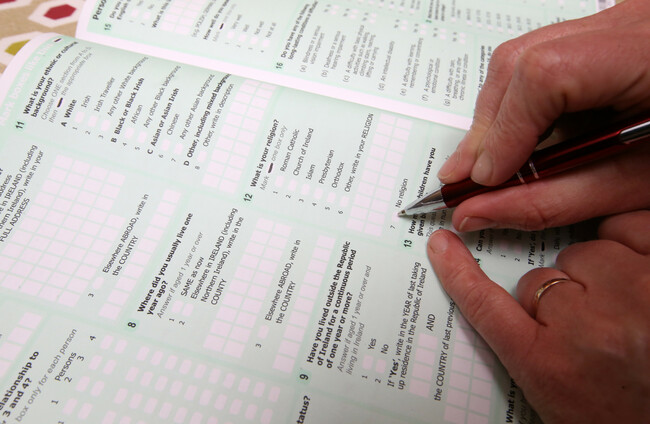
THIS YEAR’S CENSUS will take place on Sunday, 3 April.
The nationwide survey was launched by the Taoiseach and the Central Statistics Office at Government Buildings this morning.
A team of 5,100 enumerators has started the process of delivering over two million forms to every household in the country.
The forms must be completed on census night and will be collected by an enumerator before 6 May. Everyone present in Ireland on 3 April must be included on a census form.
Speaking at the launch, Micheál Martin said that by counting each and every single person in Ireland, the census provides a uniquely comprehensive account of our population and shows us where and how it is changing.
“We can see the age profile of our population, or society’s ethnic makeup, and the languages spoken in homes around the country. We will learn about the numbers of family carers, and the levels of volunteerism across our communities, and much, much more. The census tells us about how we live today, and we can use that information to plan for a better tomorrow,” he said.
Future decisions and services in areas like housing, transport and education rely on the info gathered for #Census2022 on April 3.
— Micheál Martin (@MichealMartinTD) March 3, 2022
So, the motto for this year is ‘Be Counted’.@CSOIreland https://t.co/NHAoDo40dO
The last census was carried out on 24 April 2016, and showed that the total population of Ireland was 4,761,865 – an increase of almost 174,000 people (3.8%) since 2011.
Censuses are normally held every four or five years and the latest edition was due to be carried out on 18 April last year, but was delayed due to the Covid-19 pandemic.
The decision to postpone was based on a need to ensure safety of public and CSO staff as well as the need to deliver a census with the highest possible response rate.
“Dealing with Covid-19 for the past two years has impacted Ireland significantly, and I am sure this time period will be a source of much analysis in years to come. On the night of 3 April, we will all have a chance to get involved in preserving that history for future generations,” Martin said.
The questionnaire covers topics such as age, marital status, gender, place of birth, occupation and housing characteristics, with the results used to draft effective government policy.
New questions
Several new questions have been added to this years’ census following a consultation process held in late 2017 inviting views on changes to the census form.
Over 400 submissions were received from members of the public, government departments, interest groups and other organisations. The CSO said it chose a range of areas which broadly represent the population of Ireland.
Among the new questions to be included are how many working smoke alarms are in your accommodation, and what type of internet connection does your household have.
Another new question asks people what time they usually leave work, school, college or childcare, while another asks people if they engage in any sort of voluntary work.
Other questions relate to working from home, tobacco use and access to childcare.
For the first time, the census form will also include an optional ‘time capsule’ section, which will give each household the opportunity to write a message to future generations.
The messages will be stored along with the census forms for the next 100 years before being released to the public in 2122.
Ireland has been conducting Censuses of Population since 1821.
Members of the public must complete their census form, and can be prosecuted for not doing so correctly.
Census forms are available in Irish and English while guides are also available in another 22 languages to assist those for whom Irish or English is not a first language.
A range of additional accessibility supports and guides are available on census.ie.
With reporting by Jane Moore

To embed this post, copy the code below on your site














have your say